📋 In This Article
Case Background
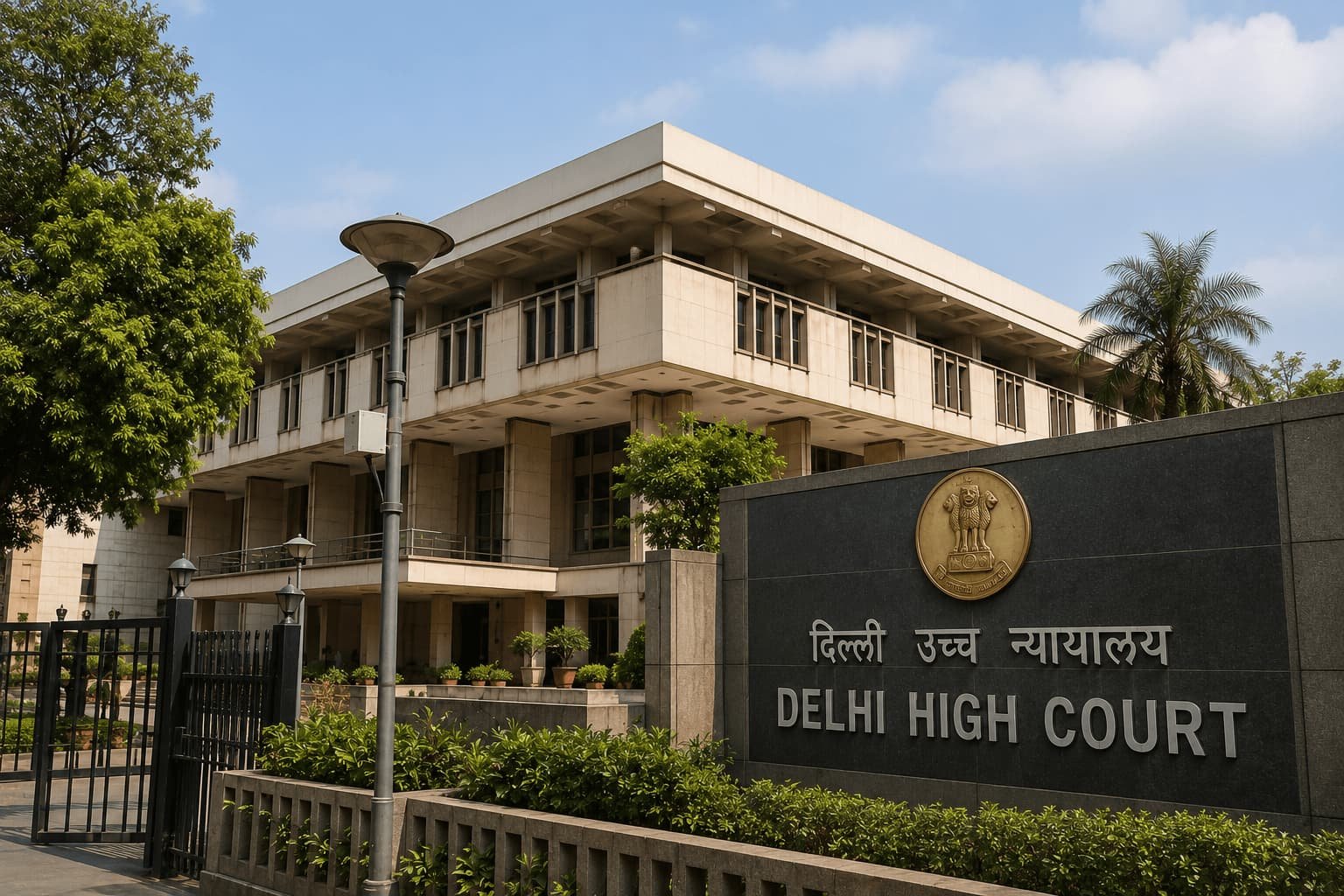
On 21 April 2026, a Division Bench of the Delhi High Court comprising Justice V. Kameswar Rao and Justice Manmeet Pritam Singh Arora heard an appeal filed by Mr. Akash Arora, trading as M/S Grand Chemical Works, against an interim injunction dated 28 March 2026 passed by a learned Single Judge in I.A. No. 46336/2024 in CS (COMM) No. 1052/2024. The Single Judge had restrained the Appellant from using certain trade dresses on its Toilet Cleaner, Glass Cleaner and Disinfectant products, on an application filed by Reckitt and Colman (Overseas) Hygiene Home Limited — the proprietor of the well-known HARPIC and COLIN brands.
Significantly, the Division Bench was not asked to reconsider the injunction itself at this stage. The appeal instead raised a narrow, practical prayer: permission for the Appellant to exhaust its existing stock — both packaged goods already in the market and unpackaged material lying in its factory — for two of the three injuncted products, namely Toilet Cleaner and Glass Cleaner, sold under the Appellant's own trademark GAINDA. No relief was sought for Surface Cleaner, which remained fully covered by the injunction.
| Case Title | Akash Arora (Trading as M/S Grand Chemical Works) v. Reckitt and Colman (Overseas) Hygiene Home Limited & Ors. |
| Case Number | FAO(OS) (COMM) 88/2026 & CM APPL. 22574-75/2026 |
| Citation | Not yet reported |
| Court | High Court of Delhi (Division Bench) |
| Date | 21 April 2026 |
Upload this PDF to /Blog/judgments/ folder on your server
💼 Adv. Nikhil Soni & Co. — 23+ years of exclusive IP practice, 5000+ trademarks filed across India. We personally handle every IPR matter. Book a free consultation →
The Appellant's Case for a Run-Out Period
Appearing for the Appellant, Mr. Darpan Wadhwa, senior counsel, sought a transitional period to clear existing inventory rather than an outright exemption from the injunction. The submissions rested on the following points:
- Inventory already in the marketAn affidavit dated 10 April 2026 disclosed that 7,15,000 packaged bottles of Toilet Cleaner and 2,15,000 packaged bottles of Glass Cleaner were already with distributors and retailers before the injunction was granted
- Unfinished packaging materialA further 2,40,000 empty Toilet Cleaner bottles and 1,20,000 empty Glass Cleaner bottles — procured from third-party vendors but not yet filled — were lying at the factory. The Appellant sought 90 days to complete packaging and one year for retailers to liquidate the combined stock
- Distinctiveness of GAINDAThe Appellant argued that GAINDA is highly distinct from HARPIC and COLIN, ruling out any likelihood of confusion, and that the dispute was strictly limited to bottle shape — to be decided later on merits
- Delay and balance of equitiesThe Appellant claimed to have sold these products since 2019 (the suit itself records sales since 2016). The suit was filed only in 2025, and the injunction followed in March 2026 — a timeline said to justify a reasonable run-out period
- Economic and environmental wasteDiscarding the inventory would render it "dead waste," causing financial hardship and environmental harm. The Appellant offered audited statements and sales invoices to protect the Respondent's interests
- Not a fly-by-night operatorWith a turnover exceeding Rs. 50 crores, the Appellant argued it was an established business capable of fully accounting for its sales
- Merits reservedThe Appellant reserved the right to argue on appeal that the bottle shapes are purely functional and that the Respondent's design registrations for the bottles have already lapsed
The disclosed inventory, as summarised in the Appellant's affidavit, is set out below:
| Product Category | Market Stock (Pieces) | Plant + Vendor Stock (Pieces) | Total Inventory (Pieces) |
|---|---|---|---|
| Toilet Cleaner | 7,15,000 | 2,40,000 | 9,55,000 |
| Glass Cleaner | 2,15,000 | 1,20,000 | 3,35,000 |
| Surface Cleaner (no relief sought) | 26,000 | 35,000 | 61,000 |
| Total | 9,56,000 | 3,95,000 | 13,51,000 |
The Respondent's Opposition
Mr. Chander M Lall, senior counsel for Reckitt and Colman, resisted the prayer on several grounds:
- Injunction would be negatedThe volume of stock claimed was substantial — permitting its sale would keep infringing goods in circulation for a long period, defeating the purpose of the injunction
- Conditional permission onlyNo such permission should be granted unless the Appellant accepted the Single Judge's order as final and conceded the Respondent's proprietary claims
- Unreliable figuresThe stock figures in the 10 April 2026 affidavit were said to contradict pleadings in a previously filed and later withdrawn application, I.A. No. 8747/2026
- Market share disparityThe Respondent holds a 78% market share for these products against the Appellant's 0.8% — given the Appellant's slow sales pace, the stock would remain in the market for years
- Repackaging is feasibleThe liquids are non-perishable and can be repackaged in non-infringing trade dress; the empty plastic bottles have no shelf life, so no equity favours preserving them
- Post-injunction conductEven after the injunction, the Appellant allegedly adopted another bottle shape said to be deceptively similar. The Respondent also stated it learned of the infringement only through enforcement proceedings against a third-party bottle manufacturer
The Delhi High Court's Conditional Order
The Division Bench declined to treat the request as an all-or-nothing choice. Instead, it fashioned a structured, conditional compromise — permitting a run-out period while actively minimising the risk of continued consumer confusion.
The Court reasoned that since the Appellant had been in the market since 2016, it was bound to have accumulated inventory by the time the injunction was granted, making some transitional period necessary to balance the equities. It found that the environmental waste and financial loss of destroying the stock outweighed any immediate harm to the Respondent, particularly since all sales would be inventoried and backed by audited accounts.
Mandatory Design Modifications
To reduce the risk of confusion during the run-out phase, the Court permitted the empty bottles to be packaged and sold only with visual changes:
The 2,40,000 empty bottles must be packaged and sold using a yellow cap and a revised yellow label — which the Court found substantially reduced the similarity with the Respondent's packaging.
The 1,20,000 empty bottles must have the blue spray nozzle replaced with a white spray nozzle before sale.
The Court also permitted the Respondent's representatives to visit the Appellant's premises within three days — by 24 April 2026 — to verify invoices, goods ledgers and the physical count of empty bottles, addressing the Respondent's concerns about the reliability of the disclosed figures.
Strict Phased Deadlines
Rejecting the Appellant's request for a one-year liquidation window, the Court imposed a considerably tighter, multi-stage timeline:
| Deadline | Requirement |
|---|---|
| 31 May 2026 | Complete packaging of all empty bottles with the modified trade dress; compliance affidavit due 1 June 2026 |
| 31 July 2026 | Appellant and distributors to complete sales to retailers; unsold stock after this date must be recalled; disclosure affidavit due 7 August 2026 |
| 31 December 2026 | Retailers to complete sales to consumers; remaining stock must be recalled thereafter; final disclosure affidavit due 7 January 2027 |
The Court further directed the Appellant's proprietor to file, within one week, an affidavit undertaking to abide by all the conditions imposed — failing which the Appellant would lose the benefit of the order altogether. It clarified that these directions were passed "without expressing any opinion on the merits of the Appellant's challenge to the impugned judgment," and held that issuing such conditional directions was well within its jurisdiction as an appellate court considering a stay application. The appeal was listed for further hearing on 8 July 2026.
Balancing Equities in Trade Dress Injunctions
This order is a useful illustration of how Indian courts approach the aftermath of a trade dress or trademark injunction where the defendant has genuine, pre-existing inventory. Rather than treating the injunction as an immediate, absolute bar on all dealings, the Division Bench weighed the economic and environmental cost of destroying lawfully manufactured stock against the trademark owner's interest in stopping consumer confusion — and structured a middle path.
Three features of the order stand out. First, permission was conditional on visible packaging changes, so that even during the transition period the marketplace risk of confusion was reduced rather than left unchanged. Second, the Court built in independent verification — allowing the Respondent to physically check the Appellant's stock claims rather than relying solely on the Appellant's affidavit. Third, the timeline was deliberately shorter and more tightly staged than what the Appellant had requested, with recall obligations and disclosure affidavits at every stage, so that the "run-out" could not be stretched indefinitely.
Importantly, the Court was careful to record that none of this reflected any view on the underlying merits — including the Appellant's contention that the bottle shape is functional and that the Respondent's design registrations have lapsed. Those questions remain fully open in the appeal.
Key Lessons
- A run-out period is discretionary, not automaticCourts may permit a defendant to exhaust pre-existing stock after an injunction, but only where equities genuinely favour it — this is not a right that follows automatically from having inventory on hand
- Packaging modification is a common middle pathRather than an outright bar or an unconditional exemption, courts increasingly use targeted trade dress changes — colour, cap, nozzle or label — to reduce confusion while a transitional sale continues
- A distinct house mark does not by itself defeat a trade dress claimSelling under a clearly distinct brand name like GAINDA did not exempt the Appellant from trade dress obligations — packaging and bottle shape are assessed independently of the word mark
- Contemporaneous, consistent inventory records matterThe Respondent's challenge to the reliability of the Appellant's stock figures — based on inconsistencies with an earlier, withdrawn application — shows why businesses should maintain accurate, consistent inventory disclosures from the outset
- Post-injunction conduct is scrutinisedThe Respondent's allegation that the Appellant adopted another similar bottle shape after the injunction is a reminder that a party's conduct during litigation can affect how future applications are viewed
- Audited accounts strengthen a stock-exhaustion requestOffering audited statements and sales invoices — so that any eventual loss can be compensated through the final decree — made it easier for the Court to permit a transitional sale without prejudicing the Respondent
Why Choose Adv. Nikhil Soni & Co.?
- Personal handling by senior advocateAdv. Nikhil Soni personally handles every trademark and trade dress matter — clients deal directly with the advocate, not junior staff
- 23+ years, 5000+ trademarksExclusive IP practice since 2001 — trademark, patent, copyright, design and trade secret
- All India coverageAuthorised to appear before all five Trade Marks Offices and IP Courts across India
- End-to-end serviceSearch, filing, objection reply, enforcement and litigation — complete IP lifecycle management
Frequently Asked Questions
What did the Delhi High Court decide in Akash Arora vs Reckitt and Colman?
On 21 April 2026, a Delhi High Court Division Bench of Justice V. Kameswar Rao and Justice Manmeet Pritam Singh Arora permitted Akash Arora (trading as M/S Grand Chemical Works, selling under the mark GAINDA) to exhaust his existing Toilet Cleaner and Glass Cleaner stock during the pendency of his appeal against a Single Judge's trade dress injunction obtained by Reckitt and Colman, subject to mandatory packaging modifications, phased deadlines and disclosure affidavits.
Can a defendant sell existing stock after a trademark or trade dress injunction in India?
Indian courts have discretion to grant a limited stock-exhaustion or run-out period even after an interim injunction, if equities favour it — for example where the defendant has genuine pre-existing inventory and destruction would cause disproportionate economic or environmental harm. Such permission is conditional, not automatic, and is typically tied to packaging changes, physical verification and strict, time-bound liquidation deadlines.
What packaging changes did the Delhi High Court order for the GAINDA products?
For Toilet Cleaner, the Court directed that the 2,40,000 empty bottles be packaged only with yellow caps and a revised yellow label. For Glass Cleaner, the Court directed that the blue spray nozzle on the 1,20,000 empty bottles be replaced with a white spray nozzle, holding that these changes substantially reduced the similarity with the Respondent's packaging.
What is the deadline for GAINDA Toilet Cleaner and Glass Cleaner stock to be cleared from the market?
The Court set three deadlines: packaging of all empty bottles to be completed by 31 May 2026; sale from the Appellant and its distributors to retailers to be completed by 31 July 2026, with unsold stock recalled after that date; and sale by retailers to consumers to be completed by 31 December 2026, with any remaining stock recalled thereafter. Compliance affidavits are due after each stage.
Does this order decide the trade dress dispute between GAINDA and HARPIC/COLIN on merits?
No. The Delhi High Court expressly clarified that its directions on stock exhaustion were passed purely to balance equities during the pendency of the appeal, without expressing any opinion on the merits of the underlying trade dress dispute — including the Appellant's contention that the bottle shapes are functional and that the Respondent's design registrations have lapsed.
What happens if unsold GAINDA stock remains with retailers after the final deadline?
Any stock remaining with the Appellant, its distributors, or retailers after the applicable deadline must be recalled. The Appellant is required to file disclosure affidavits confirming the status of sold and unsold inventory at each stage, backed by audited accounts and sales invoices.
Official Resource: Visit Trade Marks Registry, IP India for authoritative government information.